Zenless Zone Zero: the action game hiding behind the style
New Eridu looks like a fashion shoot and plays like a fighting game. What the parry-and-swap combat actually demands, how the Hollows work, and who this suits.

Contains sponsored links. We may earn a commission if you install a game, at no cost to you.
 Free to Play · Zenless Zone ZeroPlay Zenless Zone Zero free on PC▶ Get In the Game
Zenless Zone Zero is the one HoYoverse game people consistently misjudge from screenshots. The presentation (neon, comic panels, a soundtrack that behaves like a character) reads as style over substance. The combat underneath is the most demanding the studio has shipped.
In this guide:
The setting, briefly
The world was largely consumed by the Hollows: hostile, shifting dimensions that appear without warning and rewrite the space inside them. New Eridu is the last city that learned to live beside one instead of fleeing it, and it built an economy on the resources the Hollows produce.
You play a Proxy: an off-the-books guide who steers other people's teams through Hollow interiors from behind a screen. It is a neat justification for the game's structure: you are the one giving orders, and the cast are the ones taking the hits.
Free to Play · Zenless Zone ZeroPlay Zenless Zone Zero free on PC▶ Get In the GameCombat is a three-character fighting game
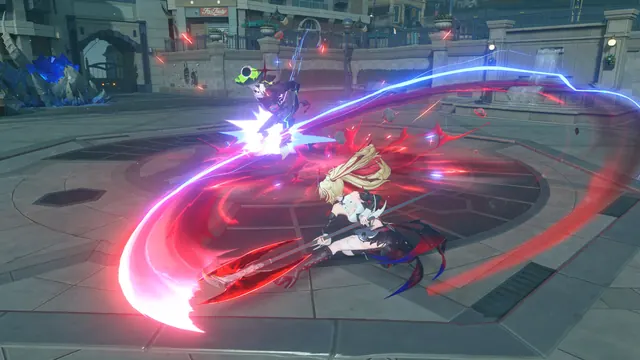
You field three agents and swap constantly, but the swap is not a menu action. It is the mechanic. Time a switch into an incoming attack and you get a Defensive Assist: the incoming character absorbs the hit and counters. Land enough pressure to break an enemy's stagger gauge and the whole squad chains together for a burst window.
The result is a rhythm closer to a character-action game than to an RPG. You are reading attack animations, deciding whether to dodge or to parry into an assist, and building toward the stun window. Mash through it and the game will let you, for a while. The higher difficulties do not.
- Five attributes (Physical, Fire, Ice, Electric and Ether) decide what enemies are weak to.
- Five specialities (Attack, Stun, Anomaly, Support and Defence) decide what a character does for the squad.
- A working team is usually one damage dealer, one stun-builder and one support. Three damage dealers is the classic new-player mistake.
Learn one character's dodge-counter timing properly before you touch the roster. In this game the difference between clearing and failing is a parry window, not a stat sheet.
Yuki Tanaka
The Hollow navigation, and how it changed
At launch, Hollow exploration was presented as a grid of TV screens you moved a marker across. Puzzle-ish, deliberately abstract, and the single most divisive thing about the game. Players said so loudly, and the studio scaled it back over subsequent updates in favour of direct, on-foot exploration.
Worth knowing if you bounced off it early: the version being described in old reviews is not the version you would install today.
Team-building around attributes and specialities
Because the five attributes and five specialities interact in specific, learnable ways, team-building here is closer to deckbuilding than roster management. A stun-builder whose attribute doesn't match your damage dealer's weakness exploit is contributing far less than one that does. Reading enemy weaknesses before a fight and adjusting your three-agent lineup accordingly is a habit worth building early rather than defaulting to the same team for every encounter.
Running a video store between missions
Between Hollow dives, you run Randy's Video, a small storefront that doubles as the game's hub for side content, character interactions and a surprisingly involved little management loop of its own. Stocking shelves, chatting with regulars, watching the neighborhood's cast of characters drift in and out. It's an odd juxtaposition against the fighting-game combat, and that contrast is deliberate: New Eridu wants to feel lived-in between fights, not just be a menu you pass through to reach the next Hollow.
Difficulty modes and what they actually test
Standard story difficulty is forgiving enough that mashing through fights mostly works, which is exactly why the game gets misjudged as shallow by players who never push past it. The higher difficulty modes (timed clears, harder enemy patterns) are where the parry-and-swap system actually gets tested, and they're the honest answer to anyone wondering whether the combat has real depth. Treat the story campaign as the tutorial and the endgame difficulty modes as the real pitch.

The free-to-play shape
The city, the story, the Hollow content and the difficulty modes are free. The monetised layer is the agent and W-Engine gacha, plus a seasonal pass. As in the studio's other games, the practical limiter on progress is a refilling energy currency, not a paywall. You can play as long as you like, but the gear grind is rationed by the day.
Who it is for
- Players who want action-game execution (parries, cancels, timing) inside a free live-service game.
- Anyone who likes a tight urban setting over a sprawling map: New Eridu is a few dense districts, not a continent.
- Style-first players, honestly. The presentation is the point, and it holds up.
If it is the studio's open-world scale you are after instead, Genshin Impact is the other end of the same catalogue, and Neverness to Everness sits between the two. Urban, free, and built for combat depth.

Free on Windows PC. The prologue is short and it is a fair audition for the rest.
Give the combat a real chance past the tutorial before deciding. The earliest fights are deliberately gentle, and the parry-and-swap system doesn't show its actual depth until an enemy pattern forces you to use it properly.
New Eridu is also small enough to feel known after a few sessions, in a way most open-world alternatives on this catalog simply aren't built to be. That compactness is part of the appeal for players tired of sprawling maps.